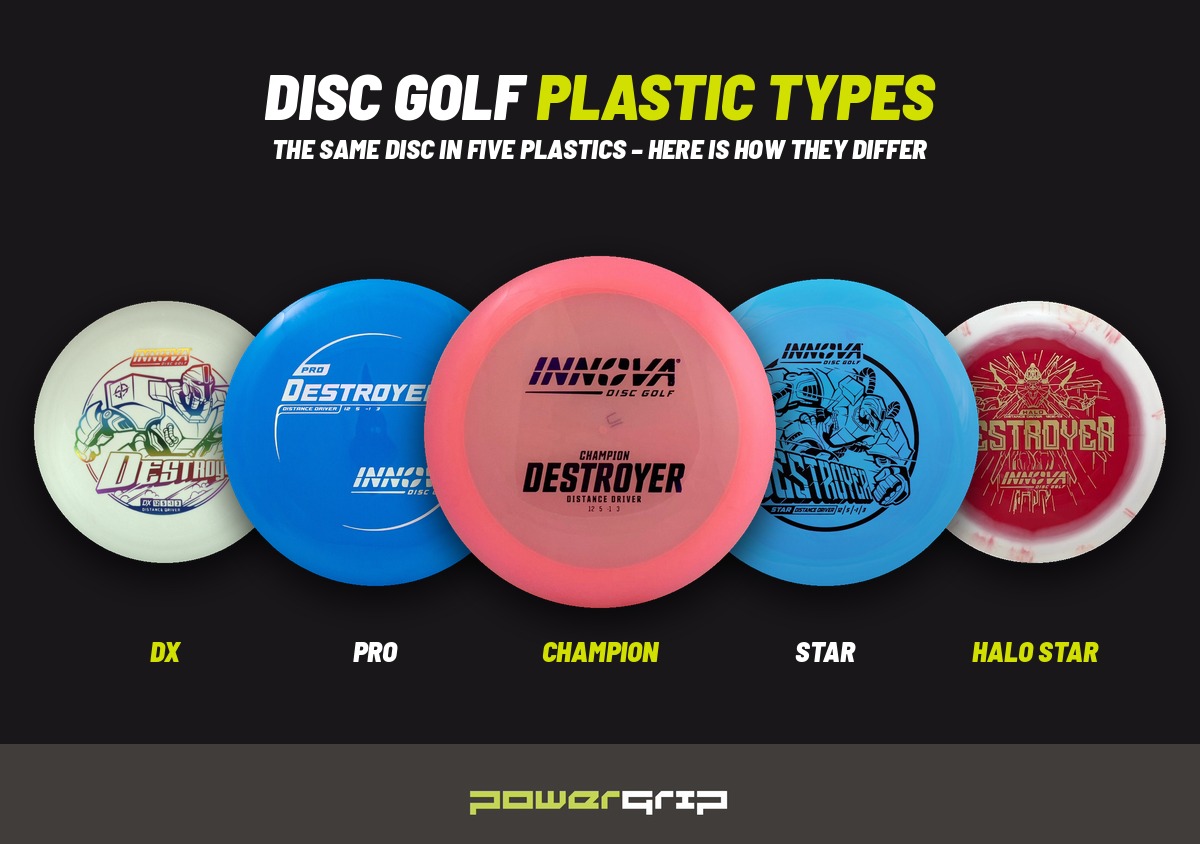
In brief: the plastic determines three things, namely grip, durability and how the disc’s flight changes over time. Almost every manufacturer has three basic types: an inexpensive base plastic with good grip, an opaque premium (the best combination of grip and durability) and a translucent premium (the most durable and usually the most overstable). For putters the usual choice is a base plastic, and for drivers and midranges a premium.
This guide first goes through the general principles of plastics and then the plastics of 13 manufacturers, in the order in which their discs sell best at Powergrip (sales figures for 2026 to date). The plastics of each manufacturer are listed by sales in the same period, starting with the best-selling one, and further plastics from the manufacturer are included at the end of the tables.
Contents
- What the plastic affects
- The three basic types and the speciality plastics
- The effect of the plastic on flight and wear
- How to choose the plastic
- Manufacturers’ plastics side by side
- Discmania
- Innova
- Axiom Discs
- MVP Disc Sports
- Latitude 64
- Discraft
- Prodigy Disc
- Westside Discs
- Kastaplast
- Streamline Discs
- Clash Discs
- Dynamic Discs
- Prodiscus
- Frequently asked questions
What the plastic affects
The mould of a disc golf disc determines the shape of the disc and through that its flight numbers. The plastic determines how the disc feels in the hand, how well it survives impacts and how quickly its flight changes. The same mould, for example the Innova Destroyer or the Discmania FD, is often available in five or more plastics, and the differences are clear in practice.
- Grip: how securely the disc stays in the hand in dry, wet and cold conditions. Base plastics and opaque premium plastics grip best, and translucent ones are the most slippery when wet.
- Durability: how well the disc withstands trees, rocks and asphalt. Translucent premium plastics last best, base plastics worst.
- Stability: the same mould is slightly differently stable in different plastics, and as it wears the disc becomes more understable.
- Stiffness: a stiff disc releases cleanly from the hand and tolerates torque, while a soft one stops better on the ground and in the basket and works in the cold.
- Weight: some plastics make it possible to produce discs that are clearly lighter than usual.
- Price: base plastics are the least expensive and special runs the most expensive. Prices may vary.
The three basic types and the speciality plastics
| Type | Grip | Durability | Price range | Typical use | Examples |
|---|---|---|---|---|---|
| Base plastic | Excellent | Weakest, wears quickly | Least expensive | Putters, starter sets, discs that are meant to be worn in | Innova DX, Discmania D-Line and P-Line, Latitude 64 Zero and Retro, MVP Electron, Prodigy 300, Kastaplast K3 |
| Mid-range plastic | Very good | Moderate | Mid-priced | Putters and midranges, when grip and a little more durability are wanted | Innova Pro, KC Pro and XT, Discraft Jawbreaker, Prodigy 350G |
| Opaque premium | Good or very good | Very good | Premium | The all-round choice for every throwing disc | Innova Star, Discmania S-Line and Q-Line, Discraft ESP, Latitude 64 Gold, MVP Neutron, Kastaplast K1, Clash Steady |
| Translucent premium | Good when dry, more slippery when wet | Best | Premium | Drivers, overstable discs, wooded and rocky courses | Innova Champion, Discmania C-Line, Discraft Z Line, Latitude 64 Opto, MVP Proton, Westside VIP |
PuttersMidrangesFairway driversDistance drivers
Speciality plastics
- Glow, that is plastic that glows in the dark: it is charged with a UV lamp or with light. A glow blend is often slightly stiffer and more stable than the standard version. In our experience the brightest glowing ones are MVP’s and Axiom’s Eclipse as well as Kastaplast’s K1 Glow.
- Light plastics: discs made with microbubbles or with a lighter blend, such as Innova Blizzard Champion, Latitude 64 Opto Air and Zero Gravity, Discraft Z Lite, Prodigy Air as well as MVP’s and Axiom’s Fission. A light disc flies further at a calm arm speed but is more sensitive to wind. The lightest plastics also float: Latitude 64 Zero Gravity, Dynamic Discs Drift and Kastaplast K4.
- Soft and flexible versions: Innova GStar, Discraft FLX, the Soft versions from MVP, Axiom and Kastaplast as well as Prodigy’s G plastics. At their best in the cold and in approach shots.
- Two-coloured halo, orbit and horizon plastics: the rim and the centre are of different colours. The difference is mainly in appearance, but halo versions are often a touch stiffer and more stable.
- Colour blends and sparkles: swirl, burst, cosmic, spectrum, metal flake and glimmer. The properties match the base plastic, and metal flake is typically slightly more overstable.
- Recycled and bio-based plastics: Kastaplast K1 Grind, Prodigy ReBlend, MVP and Axiom R2 Neutron, Dynamic Discs BioFuzion as well as the plant-based Clash Planty.
- Two-plastic constructions: MVP’s and Axiom’s GYRO overmould, in which a denser rim increases rotational stability, Discmania’s Q-Line Premier, in which mass has been moved to the rim, Latitude 64’s Project Grip and ChainGrip, in which the surface or the outer rim is particularly grippy, Clash’s Tone, in which the lower part of the rim is of a stiffer plastic, and Discraft’s Fuzed Line.
Glow discsNew arrivalsSpecials
The effect of the plastic on flight and wear
The flight numbers stated by the manufacturer apply to the mould, not to an individual plastic. In practice the same mould behaves slightly differently in different plastics, because the plastic shrinks by a different amount as it cools and this affects the dome of the flight plate and the height of the seam on the rim.
- Translucent premium is on average the most overstable and keeps its stability the longest.
- Opaque premium is on average slightly straighter and often has a touch more glide.
- Base plastic is often close to the flight numbers when new but becomes understable quickly.
- Light plastics produce discs that are more understable and glide further.
- Glow, halo and metal flake versions are often slightly more stable than their base plastic.
Wear is not purely a drawback. Many experienced players throw the same mould at several stages of wear: a new premium disc is the stable version and a worn-in base plastic disc the straight or turning version. If you want a disc that has already been thrown in, used discs are an inexpensive way to try one. It is worth remembering that the differences are averages: the production run, the weight and the shape of the individual disc also have an effect.
How to choose the plastic
By disc type
- Putting putter: a grippy base plastic or a mid-range plastic. Hardness is a matter of taste: a soft one stays in the chains more easily, a hard one releases from the hand more cleanly.
- Driving putter and approach disc: a premium plastic, because the disc takes impacts and is meant to stay the same.
- Midrange: an opaque premium is the safest all-round choice. A base plastic works if you want the disc to wear straight.
- Fairway driver and distance driver: a premium plastic. A sharp rim gets dented quickly in a base plastic, and the flight changes.
- Overstable wind disc: a translucent premium, so that the stability is retained.
By player
- Beginner: an inexpensive base plastic or a light premium; the most important thing is a slow and understable mould at a suitable weight. See discs for beginners.
- Regular player: the putter in a base plastic, the other discs in an opaque premium plastic. One plastic per mould makes it easier to learn the flights.
- Competitive player: the same mould in two or three plastics and stages of wear for different stabilities, plus spare copies of the most important discs from the same run.
By conditions
- Rain and damp: an opaque premium or a base plastic, and take a towel with you.
- Sub-zero weather: soft and flexible blends, because all plastics harden in the cold and hard base plastics can crack on impact.
- Wooded and rocky courses: a translucent premium lasts best.
- Darkness and dusk: a glow plastic and a UV lamp.
- Snow and long grass: a bright colour matters more than the plastic.
Discs for beginnersDisc setsOffers
Manufacturers’ plastics side by side
The table shows which plastics roughly correspond to one another across manufacturers. There are differences in feel, but with the table you can find the equivalent of a familiar plastic in another brand.
| Manufacturer | Base plastic | Opaque premium | Translucent premium | Soft or flexible | Light | Glow |
|---|---|---|---|---|---|---|
| Discmania | D-Line, P-Line, Exo, Geo, Active Base | S-Line, Q-Line, Lux | C-Line, Neo | D-Line Flex 1, Soft Exo, G-Line | Blizzard C-Line | Glow C-Line, Color Glow C-Line |
| Innova | DX | Star, Halo Star | Champion | GStar, R-Pro | Blizzard Champion | Glow Champion, Proto Glow |
| Axiom, MVP, Streamline | Electron | Neutron, Plasma | Proton | Soft versions | Fission | Eclipse, Total Eclipse |
| Latitude 64 | Zero, Retro, Sense | Gold, Grand, Project Grip | Opto | Zero Soft, Zero Megasoft | Opto Air, Zero Gravity | Moonshine |
| Discraft | Putter Line | ESP | Z Line, Big Z | FLX versions, Putter Line Soft | Z Lite | Z Glo, Mega Glo |
| Prodigy Disc | 300, 200, BaseGrip | 500, ProFlex, DuraFlex | 400, 750 | G versions, Soft, Ultra Soft | Air | 400 Glow |
| Westside Discs | BT, Origio | Tournament | VIP | BT Soft | VIP Air | VIP Moonshine |
| Kastaplast | K3 | K1 | – | K1 Soft, K4 | K4 (Sten) | K1 Glow, K4 Glow |
| Clash Discs | Hardy, Softy | Steady, Planty | Sunny | Softy | – | – |
| Dynamic Discs | Classic, Prime | Fuzion | Lucid | Classic Soft | Lucid Air, Drift | Moonshine |
| Prodiscus | Basic | Ultrium | Premium | Platinium | – | – |
1. Discmania: the plastics
Discmania is a manufacturer founded in Finland in 2006 and the best-selling disc brand at Powergrip so far in 2026. There have been three ranges: Originals (e.g. P2, MD3, FD, DD3), Evolution (e.g. Essence, Method, Instinct) and the inexpensive Active. In recent years moulds have been moved from Evolution to the Originals range; for example, the Tactic became the P4. Each range has its own plastic names, but the logic is the same: a base plastic, an opaque premium and a translucent premium.
The most important new arrival is Q-Line. It is a denser than usual premium blend that was developed for discs using Premier technology: the flight plate can be made thinner and up to 10% of the disc’s mass moves to the rim. According to Discmania this improves how well the disc retains its spin and its glide. So far in 2026 Q-Line is by a clear margin the best-selling individual plastic in our whole range.
| Plastic | Class | Properties and use |
|---|---|---|
| Q-Line | Premium | A dense, durable and grippy premium blend with a glossy surface. Used in Premier discs (including DD1, DD3, FD, MD3), in which mass has been moved to the rim. The choice when you are after maximum distance and a long service life. |
| C-Line | Premium | Translucent and the most durable of Discmania’s premium plastics. Retains its flight characteristics for a long time and is typically slightly more overstable than the same mould in S-Line. More slippery when wet than opaque plastics. |
| Neo | Premium | The semi-translucent premium of the Evolution range. According to the manufacturer it is the most durable and stiffest plastic in the range, with a surface treatment that improves grip. |
| S-Line | Premium | An opaque premium with better grip than C-Line and a slightly softer feel. Lasts well and wears in a controlled way. Popular in drivers and midranges. |
| D-Line Flex 1, 2 and 3 | Base | The base plastic of the Originals range. Excellent grip, inexpensive, wears the fastest. The number indicates the hardness: Flex 1 is the softest and Flex 3 the hardest. Our best-selling plastic in the P2 putter so far in 2026. |
| Horizon S-Line and Horizon C-Line | Speciality | A two-coloured version in which the centre and the rim are of different shades. The properties match the base plastic, and the disc stands out well against the terrain. |
| Soft Exo and Hard Exo | Base | The base plastic of the Evolution range in two hardnesses. Good grip, especially in the soft version, and wears gradually. Used above all in putters. |
| Color Glow C-Line, Glow C-Line and Glow Horizon | Speciality | Versions that glow in the dark. A glow blend is often slightly stiffer and more stable than the standard version. |
| Active Premium | Premium | The durable premium plastic of the Active series at a low price. A good first premium disc for a beginner. |
| Active Base | Base | The base plastic of the Active series. The least expensive way to start, and also found in starter sets. |
| P-Line Flex | Base | A putter plastic with the grip of D-Line but better wear resistance. According to Discmania, the P-Line made since 2025 is the most durable base plastic ever made. |
| Lux and Lux Vapor | Premium | The opaque premium of the Evolution range: extremely grippy in all conditions and retains its flight well. Vapor refers to a strong colour pattern. |
| Swirl S-Line, Special Blend S-Line, Metal Flake C-Line | Speciality | Special run versions: colour blends, deviating S-Line blends and sparkle particles. Metal Flake is typically a touch more overstable. |
| Geo | Base | The inexpensive base plastic of the Evolution range, corresponding to D-Line in Originals. |
| G-Line | Premium | A modified version of S-Line: a flexible, grippy and shock-absorbing premium blend which, according to the manufacturer, has more glide than S-Line. |
| Blizzard C-Line | Premium | C-Line with microscopic air bubbles in the rim. Makes fast drivers possible at very low weights. The lightest weights contain the most bubbles, so they may not withstand impacts as well as heavier ones. |
| Luster C-Line and Shimmer S-Line | Speciality | Appearance versions. Luster C-Line is as durable as C-Line but usually slightly more opaque, and depending on the mould its flight may differ from ordinary C-Line. Shimmer S-Line is S-Line with metallic additives, and its feel is close to ordinary S-Line. |
Powergrip’s tip: For a putter, D-Line Flex 2 or Exo; for midranges and drivers, Neo or S-Line when you want grip, and C-Line when the disc has to survive trees and stay stable. Q-Line is the choice when you are after more distance from your drivers. For a beginner, Active Premium is an inexpensive first premium disc.
2. Innova: the plastics
Innova, founded in 1983, is a pioneer of the sport and the best-known disc manufacturer in the world. For many players Innova’s plastic names are the common language of the sport: Champion and Star are the benchmarks for premium plastics and DX for base plastics.
In our experience the order of stability between the premium plastics is on average Champion, Halo Star and Star. Metal Flake Champion is more overstable than ordinary Champion and Blizzard Champion clearly more understable, because it produces considerably lighter discs.
| Plastic | Class | Properties and use |
|---|---|---|
| Star | Premium | An opaque premium: the durability of Champion and clearly better grip. Slightly softer and typically a touch less stable than Champion. Innova’s best-selling plastic at Powergrip so far in 2026. |
| Halo Star | Premium | The two-coloured version of Star, in which the rim is of a different colour from the centre. Usually slightly stiffer and more stable than standard Star. |
| Champion | Premium | Translucent and extremely durable. Usually stiffer and more overstable than the same mould in other plastics. Retains its flight for years even on wooded courses. |
| Duo | Speciality | A combination of Star and Metal Flake in which two plastics meet in the mould and every disc is unique in its colouring. Used especially in Tour Series discs. |
| DX | Base | The least expensive plastic and the best grip in dry conditions. Wears the fastest, which can be an advantage when an easily turning disc is wanted. The widest range of weights. |
| GStar | Premium | A softer and more flexible Star with a pearlescent surface. Works well in the cold and produces slightly more understable discs than Star. |
| Proto Glow, Color Glow and Classic Glow Champion | Speciality | Champion versions that glow in the dark. Often slightly stiffer and more stable. |
| Blizzard Champion | Premium | Champion with microscopic air bubbles added. Makes fast drivers possible even at weights of around 130 grams. A good choice when your arm speed is not yet enough for full-weight drivers. |
| Halo Champion | Speciality | The two-coloured halo version of Champion. |
| Pro, KC Pro and R-Pro | Mid-range | Grippier than the premium plastics and more durable than DX. Pro adds glide but wears understable fairly quickly, KC Pro is stiff and popular in putters (Aviar, Roc), and R-Pro is a soft and tacky putter plastic. |
| Metal Flake Champion and Luster Champion | Speciality | Sparkle and pearlescent versions of Champion. Metal Flake is usually more overstable than ordinary Champion. |
| XT | Mid-range | A rough-surfaced, extremely grippy blend that is more durable than the base plastics. Used mainly in putters and midranges. |
| Star I-Dye, Champion Dyed and Swirly Star | Speciality | Dyed and colour-blended versions. The properties match the base plastic. |
| Nexus | Mid-range | A stiff and grippy blend, used in the Aviar putter among others. |
| Pro Soft | Mid-range | A softer version of the Pro plastic, used in putters. |
Powergrip’s tip: For a beginner, DX or Star in lighter weights; for a developing player, Star and GStar; for hard use and headwinds, Champion and Halo Star.
3. Axiom Discs: the plastics
Axiom Discs belongs to the American MVP family and uses the same GYRO overmould technique as MVP: the core and the rim of the disc are moulded separately, and the rim is of a denser material. The mass is concentrated towards the rim, which increases the disc’s rotational stability. Axiom is recognisable by its colourful rims. The plastics are the same as at MVP and Streamline, so the feel of one brand is familiar across the whole family.
| Plastic | Class | Properties and use |
|---|---|---|
| Neutron | Premium | The opaque flagship plastic: extremely durable, good grip and the widest range of colours. For most players the best all-round choice. |
| Proton | Premium | Translucent, stiff and the most durable in the series. Typically slightly more overstable than Neutron. |
| Fission | Premium | A premium made with microbubble technology. The core is lighter, so the mass is concentrated towards the rim even more and discs can also be produced in lighter weights without the durability suffering. |
| Electron (Soft, Medium, Firm) | Base | A base plastic in three hardnesses. Excellent grip, wears faster and in a controlled way. Used mainly in putters and midranges. |
| Eclipse and Total Eclipse | Speciality | A glow plastic that in our experience is among the brightest glowing on the market. In Total Eclipse both the core and the rim glow. |
| Particle Glow Proton | Speciality | Translucent Proton with glowing particles blended in. Also available as a Soft version. |
| Plasma | Premium | A metallic-sheened premium whose colour shifts with the light. Slightly more flexible in feel than Neutron, and grippy. |
| Neutron Soft, Proton Soft and Plasma Soft | Premium | Softer and more flexible versions. Good in cold weather and in approach discs, when the disc is meant to stop quickly. |
| Cosmic Neutron and Cosmic Electron | Speciality | Colour-blended swirl versions. The properties match the base plastic. |
| R2 Neutron | Premium | Neutron made from recycled production material. Darker colouring, the same performance. |
| Prism (Proton, Neutron, Plasma) | Speciality | Striking special colourings. The flight and durability characteristics follow the base plastic. |
Powergrip’s tip: Neutron is a safe all-round choice and Electron Firm or Soft for putters. Fission when you want a lighter driver with premium durability, and Eclipse or Particle Glow Proton Soft for playing in the dark.
4. MVP Disc Sports: the plastics
MVP Disc Sports is the developer of the GYRO overmould technique. On MVP discs the rim was for a long time always black, but from the 2026 production runs onwards the rim is white. The change affects only the appearance, and discs with black rims are still on sale. The range of plastics is the same as at its sister brands Axiom and Streamline. In our sales so far in 2026 the order for MVP is Neutron, Proton, Fission and Electron.
| Plastic | Class | Properties and use |
|---|---|---|
| Neutron | Premium | The opaque flagship plastic: extremely durable, good grip and the widest range of colours. For most players the best all-round choice. |
| Proton | Premium | Translucent, stiff and the most durable in the series. Typically slightly more overstable than Neutron. |
| Fission | Premium | A premium made with microbubble technology. The core is lighter, so the mass is concentrated towards the rim even more and discs can also be produced in lighter weights without the durability suffering. |
| Electron (Soft, Medium, Firm) | Base | A base plastic in three hardnesses. Excellent grip, wears faster and in a controlled way. Used mainly in putters and midranges. |
| Eclipse and Total Eclipse | Speciality | A glow plastic that in our experience is among the brightest glowing on the market. In Total Eclipse both the core and the rim glow. |
| Particle Glow Proton | Speciality | Translucent Proton with glowing particles blended in. Also available as a Soft version. |
| Plasma | Premium | A metallic-sheened premium whose colour shifts with the light. Slightly more flexible in feel than Neutron, and grippy. |
| Neutron Soft, Proton Soft and Plasma Soft | Premium | Softer and more flexible versions. Good in cold weather and in approach discs, when the disc is meant to stop quickly. |
| Cosmic Neutron and Cosmic Electron | Speciality | Colour-blended swirl versions. The properties match the base plastic. |
| R2 Neutron | Premium | Neutron made from recycled production material. Darker colouring, the same performance. |
| Eclipse Electron and Color Glow Eclipse | Speciality | Versions of the glow plastic: a glowing base plastic for putters and a coloured glow. |
Powergrip’s tip: Neutron for general use, Proton as the most durable for wooded courses and Fission when you are after a lighter disc. For a putter, Electron.
5. Latitude 64: the plastics
Latitude 64 makes its discs in Skellefteå in Sweden, and the discs of Westside Discs, Dynamic Discs and Kastaplast come from the same factory. For that reason the plastics of Latitude 64, Westside and Dynamic Discs largely correspond to one another. In addition to the standard range, Latitude has the Royal range with its own plastics (Grand, Clear and Sense).
The most recent developments concern grip. Project Grip combines two premium plastics: the surface is extremely tacky, but the core and the rim stay stiff. Project ChainGrip is a putter plastic in which the core and the inner rim are of Zero Hard plastic and the outer rim of the manufacturer’s grippiest blend to date, so that the putt would stay in the chains better.
| Plastic | Class | Properties and use |
|---|---|---|
| Opto | Premium | Translucent and the most durable plastic in Latitude 64’s standard range. Retains its flight for a long time, slightly more slippery when wet. |
| Gold | Premium | An opaque premium: the durability of Opto and better grip. A popular all-round choice for drivers and midranges. |
| Grand | Premium | The premium plastic of the Royal range. Grippy, durable and refined in feel. |
| Zero Soft, Medium and Hard | Base | A putter plastic in three hardnesses. Excellent grip, wears faster. Medium is our best-selling version so far in 2026. |
| Zero Gravity | Mid-range | An extremely light version of the Zero plastic: the discs typically weigh around 120–130 g and float in water. A light disc flies further with less force, so the plastic suits children, beginners and players with a calm arm speed, as well as holes with water. |
| Royal Clear | Premium | The transparent premium of the Royal range. According to the manufacturer it has a slightly stiffer feel, reliable grip and high durability, and when new the disc may be a touch more stable than the same mould in other plastics. Also used in Team Series signature discs. |
| Opto Air | Premium | Opto with microbubbles added. Lighter weights with premium durability. |
| Orbit (Opto, Gold, Grand, Zero) | Speciality | A two-coloured version in which the rim and the centre are of different colours. The properties follow the base plastic. |
| Project Grip | Premium | An extremely tacky surface and a stiff core that withstands torque. Works in damp and cold conditions too. |
| Project ChainGrip | Speciality | A two-plastic putter solution: a stiff Zero Hard core and an extremely grippy outer rim. Latitude 64 describes it as an experimental prototype. Available in the Pure and Peak putters among others. |
| Moonshine (Opto, Zero) | Speciality | Glow versions that glow in the dark. |
| Zero Pro | Mid-range | A more advanced version of the Zero putter plastic: a stiff flight plate, a tacky surface and clearly better durability than standard Zero. The grip also holds in damp and cold conditions. Available in the Pure, Peak, Keystone, Dagger, Hope and Mercy putters among others. |
| Retro and Retro Burst | Base | An inexpensive base plastic for drivers and midranges. Good grip, wears quickly. |
| Sense | Base | The grippy base plastic of the Royal range, used above all in putters. |
| Opto-X and Gold-X | Speciality | Slightly stiffer and more stable blends used in players’ signature series. |
| Glimmer and Sparkle | Speciality | Sparkle versions. The properties follow the base plastic. |
| Zero Megasoft | Base | The softest version of the Zero putter plastic. |
| Recycled | Mid-range | A premium-type blend made from recycled material. The feel is close to premium plastic, but the durability is not quite at the same level. |
Powergrip’s tip: Opto is the most durable all-round choice and Gold the same with more grip. From the Royal range, Grand and Clear when you want a more refined feel. For a putter, Zero Medium or the more durable Zero Pro, and if your hold slips when wet, Project Grip.
6. Discraft: the plastics
Discraft is a long-established American manufacturer whose best-known moulds are the Buzzz, the Zone and the Luna. The basic division of the plastics is clear: ESP is an opaque and grippy premium, Z Line the translucent and most durable one.
| Plastic | Class | Properties and use |
|---|---|---|
| Z Line | Premium | Translucent and the most durable plastic in Discraft’s standard range. Typically stiffer and more overstable than ESP. Discraft’s best-selling plastic at Powergrip so far in 2026. |
| ESP | Premium | An opaque premium with excellent grip and often a striking colour blend. Wears slowly and evenly. |
| Big Z | Premium | A stiffer and often slightly more overstable version of the Z plastic with a large stamp. |
| Jawbreaker and Z Jawbreaker | Mid-range | Jawbreaker is a speckled, extremely grippy blend for putters and midranges. Z Jawbreaker combines the durability of the Z plastic with the grip of Jawbreaker, and is used in special runs. |
| Special Blend | Speciality | Deviating blends used in special runs, often in signature discs. |
| Fuzed Line | Speciality | A combination of two premium plastics in which the plastics form a pattern on the rim. The best-known example is the BuzzzSaw, whose rim shows a pattern resembling a saw blade. Durable and grippy. The stability of the Fuzed Buzzz varies from disc to disc: according to retailers’ observations, flatter discs are more understable and have more glide than the ordinary Buzzz, while more domed ones are more stable. |
| Titanium | Premium | A stiff premium with a pearlescent surface. Extremely durable and usually slightly more overstable. |
| Supercolor and Full Foil Supercolor | Speciality | ESP printed with an image across the whole flight plate. A favourite among collector’s and gift discs. |
| Z Lite | Premium | A light Z plastic that makes drivers clearly lighter than usual. |
| Putter Line (Soft and Hard) | Base | The base plastic for putters in two hardnesses. Excellent grip. |
| ESP FLX, Z FLX and Cryztal FLX | Premium | More flexible versions. They keep their grip and flexibility in the cold and stop on the ground more quickly. |
| Cryztal Z, Z Swirl, ESP Swirl, Z Fly Dye, Metallic Z, Z Confetti | Speciality | Appearance versions: extremely clear, colour-blended, dyed or sparkling. The properties follow the base plastic. |
| Mega Glo and Z Glo | Speciality | Versions that glow in the dark. |
Powergrip’s tip: ESP when grip is what matters, Z Line when you want the disc to stay the same for years, and Big Z when you are after a stiffer and more stable version. For a putter, Putter Line or Jawbreaker.
7. Prodigy Disc: the plastics
Prodigy Disc names its plastics with numbers. The rule of thumb: the higher the number, the more durable and stiffer the plastic. The suffix G means a grippier and more flexible version. The inexpensive Ace Line range has its own plastic names. The table runs from the base plastics to the premium plastics and finally to the speciality versions.
| Plastic | Class | Properties and use |
|---|---|---|
| Ace Line BaseGrip | Base | The base plastic of the Ace Line range, corresponding to the 300 and 350G plastics. Grippy in all weather and wears in a controlled way. |
| 200 | Base | A hard and inexpensive base plastic, used mainly in putters. |
| 300 | Base | A grippy base plastic, our best-selling putter plastic so far in 2026. Wears in a controlled way. Also available in Soft, Ultra Soft and Firm versions. |
| Ace Line DuraFlex | Premium | The durable and flexible opaque premium of the Ace Line range at a low price. Also available as a glow version. |
| Ace Line ProFlex | Premium | The grippy and flexible premium of the Ace Line range. |
| 400G and 350G | Mid-range | The grippier and more flexible G versions. 350G is popular in putters. |
| 400 | Premium | Translucent, durable, glossy-surfaced and retaining its flight well. Our best-selling Prodigy premium plastic so far in 2026. |
| 500 | Premium | A premium with more grip than the 400 plastic and a slightly softer feel. |
| 750 and 750 Glimmer | Premium | Prodigy’s stiffest and most durable premium. Glimmer is the sparkle version. |
| ReBlend | Premium | A one hundred per cent recycled blend made from premium discs that did not meet production quality requirements. The feel is close to Prodigy’s premium plastics and the appearance is distinctive. |
| Air | Premium | A light premium that makes drivers lighter than usual. |
| 500 Spectrum, 750 Spectrum and Air Spectrum | Speciality | Spectrum means a colour-blended special colouring. The flight and durability characteristics match the base plastic, so 500 Spectrum is a full-blooded 500 plastic with a striking colour surface. |
| 300 Fractal and 300 Firm Fractal | Speciality | The colour-patterned version of the 300 plastic. The grip and durability match the ordinary 300 plastic, so this is not merely a collector’s version. |
| 400 Glow | Speciality | A 400 that glows in the dark. |
Powergrip’s tip: For a putter, 300 or 350G when you want grip, and 750 when the putter has to survive drives. For drivers and midranges, 400 is the glossy and slippery all-round choice, while 500 is clearly grippier and slightly softer. If you are after the best grip or a beautiful colour blend, choose 500 Spectrum, and if your grip slips in cold or wet conditions, the G plastics and 300 Fractal are safe choices. Ace Line is an inexpensive way to start.
8. Westside Discs: the plastics
Westside Discs is a brand of Finnish origin whose discs are made at the Latitude 64 factory in Sweden. The plastics correspond to Latitude 64’s plastics under different names: VIP corresponds to Opto and Tournament to Gold.
| Plastic | Class | Properties and use |
|---|---|---|
| VIP | Premium | A translucent and extremely durable plastic that retains its flight characteristics for a long time. Corresponds almost entirely to Latitude 64’s Opto. |
| Tournament | Premium | An opaque premium whose durability is on a par with VIP but whose grip is slightly better. Corresponds to Latitude 64’s Gold. |
| BT Soft, Medium and Hard | Base | A putter plastic in three hardnesses, with excellent grip. Corresponds to the Zero series. |
| VIP Air | Premium | VIP lightened with microbubbles. |
| VIP Ice | Premium | A particularly clear and glass-like VIP version. |
| VIP Moonshine | Speciality | VIP plastic with glow material added so that it glows in the dark. |
| BT Origio and Origio Burst | Base | An inexpensive base plastic for drivers and midranges. |
| VIP-X and Tournament-X | Speciality | The stiffer and grippier blends of the signature series, which are more overstable than the standard version. |
| Tournament Ring | Speciality | Tournament plastic with a ring-shaped colour effect. The properties match Tournament. |
| Tournament Rill | Speciality | Tournament plastic with an undulating colour effect that imitates the movement of water and wind. Every disc is unique in its pattern. |
| Orbit, Glimmer and Burst | Speciality | A two-coloured rim effect, sparkle and colour patterning. The properties follow the base plastic. |
| Revive | Mid-range | A recycled blend made by melting down VIP and Tournament discs that did not meet quality requirements. |
Powergrip’s tip: VIP for wooded courses, Tournament when you want more grip.
9. Kastaplast: the plastics
Stockholm-based Kastaplast, part-owned by Latitude 64, is known for one thing above all others: the K1 plastic, which is widely regarded as one of the best combinations of grip and durability in the sport. The range is deliberately narrow.
| Plastic | Class | Properties and use |
|---|---|---|
| K1 | Premium | The flagship plastic: extremely durable, exceptionally grippy and refined in feel. |
| K1 Hard | Premium | A stiffer K1, typically a touch more stable. Popular in approach discs. |
| K1 Grind | Premium | A plastic made from one hundred per cent recycled K1 production material. A coloured core and a pale rim distinguish it from ordinary K1, and the flight is intended to match the original. |
| K3 | Base | A grippy base plastic that wears faster. Used especially in putters (Reko, Berg). |
| K1 Soft | Premium | A more flexible K1 for cold weather and for players looking for a softer feel. |
| K3 Hard | Base | The stiffer version of K3. |
| K4 | Mid-range | A soft hybrid plastic between base and premium: extremely tacky, rubbery and floating in water. Marks from wear show, but the flight is retained. Used in the light Sten disc, which is intended for casual throwing, warming up and getting to know the sport. |
| K1 Glow, K1 Soft Glow and K4 Glow | Speciality | In our experience among the brightest glowing glow plastics on the market. K4 Glow is the glowing version of the K4 plastic, used in the Sten disc. |
Powergrip’s tip: K1 for almost everything and K1 Hard for approach discs, K3 for a putter. For playing in the dark, K1 Glow.
10. Streamline Discs: the plastics
Streamline Discs is the third brand in the MVP family. The discs are moulded from a single piece without an overmould rim, so the feel is traditional, but the plastics are exactly the same as at MVP and Axiom.
| Plastic | Class | Properties and use |
|---|---|---|
| Neutron and Neutron Soft | Premium | An opaque, durable and grippy premium. By a clear margin Streamline’s best-selling plastic at Powergrip so far in 2026. |
| Plasma | Premium | A metallic-sheened and grippy premium. |
| Proton | Premium | Translucent, stiff and the most durable in the series. |
| Electron (Soft, Medium, Firm) | Base | A grippy base plastic, used mainly in putters (Pilot, Stabilizer). |
| Eclipse | Speciality | A brightly glowing glow plastic. |
| Cosmic Neutron and Cosmic Electron | Speciality | Colour-blended versions. |
Powergrip’s tip: The same selection logic as at MVP and Axiom: Neutron for general use and Proton for hard wear. Eclipse is a brightly glowing choice for playing in the dark.
11. Clash Discs: the plastics
Clash Discs is a Finnish manufacturer whose discs are made in Finland. The range of plastics is clear, and the names tell you the essentials.
| Plastic | Class | Properties and use |
|---|---|---|
| Steady | Premium | Clash’s premium and by far its best-selling plastic at Powergrip so far in 2026. Extremely durable, good grip and just the right amount of flex. The feel is close to opaque premium plastics such as Star. |
| Steady Ring | Speciality | Steady as a two-coloured halo version. The same grip and feel, a more striking appearance. |
| Planty | Premium | A plastic made from plant-based, renewable raw materials. The feel resembles Steady, slightly softer and tackier, and it wears somewhat faster. |
| Tone | Speciality | A two-plastic construction: the lower part of the rim is of a stiffer plastic that withstands torque and the upper part of the disc of an extremely grippy premium blend. The appearance is three-dimensional and two-toned. |
| Hardy | Base | A hard and grippy base plastic for putters. |
| Softy | Base | The same grip as in Hardy, with a more flexible feel. |
| Sunny | Premium | A clear, that is transparent, premium blend that is stiffer than Steady. Withstands torque better and performs well in hot weather. |
Powergrip’s tip: Steady for all throwing discs, and Sunny when you want a stiffer version that withstands torque better. Hardy or Softy for putting.
12. Dynamic Discs: the plastics
Dynamic Discs’ discs are made at the Latitude 64 factory in Sweden. Lucid corresponds to Opto and Fuzion to Gold.
| Plastic | Class | Properties and use |
|---|---|---|
| Lucid | Premium | Translucent and extremely durable. Corresponds to Latitude 64’s Opto. |
| Fuzion | Premium | An opaque and grippy premium. Corresponds to Gold. |
| Classic, Classic Soft and Classic Blend | Base | Putter plastics in different hardnesses. Excellent grip. |
| Lucid Ice | Premium | A particularly clear Lucid version. |
| Lucid Air | Premium | Lucid lightened with microbubbles. |
| BioFuzion | Premium | A premium made from recycled Fuzion material. |
| Drift | Base | A new light base plastic: flexible, tacky and floating in water. The light weight brings distance with less force, so it suits beginners, juniors and holes with water. |
| Moonshine | Speciality | The version of the Lucid plastic that glows in the dark. According to the manufacturer it is slightly more overstable than the same mould in Lucid. |
| Prime | Base | An inexpensive base plastic with very good grip, designed for players taking up the sport. Also available as a glowing Prime Moonshine version. |
| Supreme | Speciality | A premium blend used in special runs. |
| Lucid-X, Orbit and Burst | Speciality | Stiffer blends used in signature series and special colourings. |
Powergrip’s tip: Lucid for general use and hard wear, Fuzion when you want more grip. For a putter, the Classic series, and for light throws, Drift.
13. Prodiscus: the plastics
Prodiscus is a Finnish manufacturer whose discs are made in Finland. There are four plastics, and the division is easy to remember.
| Plastic | Class | Properties and use |
|---|---|---|
| Ultrium | Premium | An opaque premium and, according to the manufacturer, its most durable plastic: an improved version of Premium that combines durability with good grip in the rain too. |
| Premium | Premium | A transparent and extremely durable premium. The manufacturer recommends it for discs used for many drives or approach shots. |
| Basic and Basic Hard | Base | A soft base plastic which, according to the manufacturer, offers the best grip in all conditions. At its best in putters and approach discs. Also available in a harder Hard version. |
| Platinium | Premium | A slightly softer premium whose grip and feel, according to the manufacturer, are in a class of their own. The best plastic in the manufacturer’s range for cold weather. |
Powergrip’s tip: Ultrium when you want durability and grip in the rain too, Premium for driving and approach discs, and Platinium for cold weather. For a putter, Basic or Basic Hard.
Frequently asked questions
Which plastic suits a beginner?
For a beginner, a grippy base plastic suits a putter and either a base plastic or a lighter premium plastic suits drivers and midranges. A base plastic is inexpensive and grippy, while a premium retains its flight for longer. More important than the plastic is choosing a sufficiently slow and understable disc at a suitable weight.
Which is the most durable disc golf disc plastic?
The most durable are the translucent premium plastics, such as Discmania C-Line, Innova Champion, Discraft Z Line, Latitude 64 Opto, MVP and Axiom Proton, Westside VIP and Dynamic Discs Lucid. They typically retain their flight characteristics for years.
Does the plastic affect the flight of the disc?
It does. The same disc mould is usually slightly more overstable in a translucent premium plastic than in an opaque premium plastic, and in a base plastic often the straightest or the most understable. In addition, a base plastic wears quickly, which makes the disc more understable. The differences are averages, and the production run, the dome of the flight plate and the weight also have an effect.
Which plastic is best for a putter?
For putting, most players choose a grippy base plastic, for example Discmania D-Line, Innova DX or KC Pro, Latitude 64 Zero, Axiom and MVP Electron, Prodigy 300 or 350G, Kastaplast K3 or Discraft Putter Line. A putter used for driving is worth choosing in a premium plastic, because it survives impacts better.
Which plastic works best in winter and in the rain?
In the cold the plastic hardens, so softer and more flexible blends work best, for example Innova GStar, Discraft FLX, the MVP and Axiom Soft versions, Kastaplast K1 Soft and Prodigy’s G plastics. In the rain, opaque premium plastics and base plastics grip better than translucent ones. In snow it is worth choosing a bright colour.
Why does the same disc cost a different amount in different plastics?
The price follows the raw material and the manufacturing method. Base plastics are the least expensive, premium plastics clearly more expensive and special runs, such as glow, halo and signature discs, the most expensive. A premium disc lasts many times longer, however, so per use the price difference evens out.
Are the plastics of different manufacturers comparable with one another?
In broad terms they are. Almost every manufacturer has a base plastic, an opaque premium and a translucent premium. For example Innova Star, Discmania S-Line, Discraft ESP, Latitude 64 Gold and MVP Neutron are of the same type. There are still differences in feel and grip, so it is worth trying a plastic in the hand.
The feel of a plastic is best discovered in the hand. At Powergrip’s shops in Helsinki, Tampere, Turku, Kuopio and Oulu you can compare plastics side by side, and our staff will help you choose. In the online shop the plastic can be selected from the product search filters. This guide was updated in September 2026.